
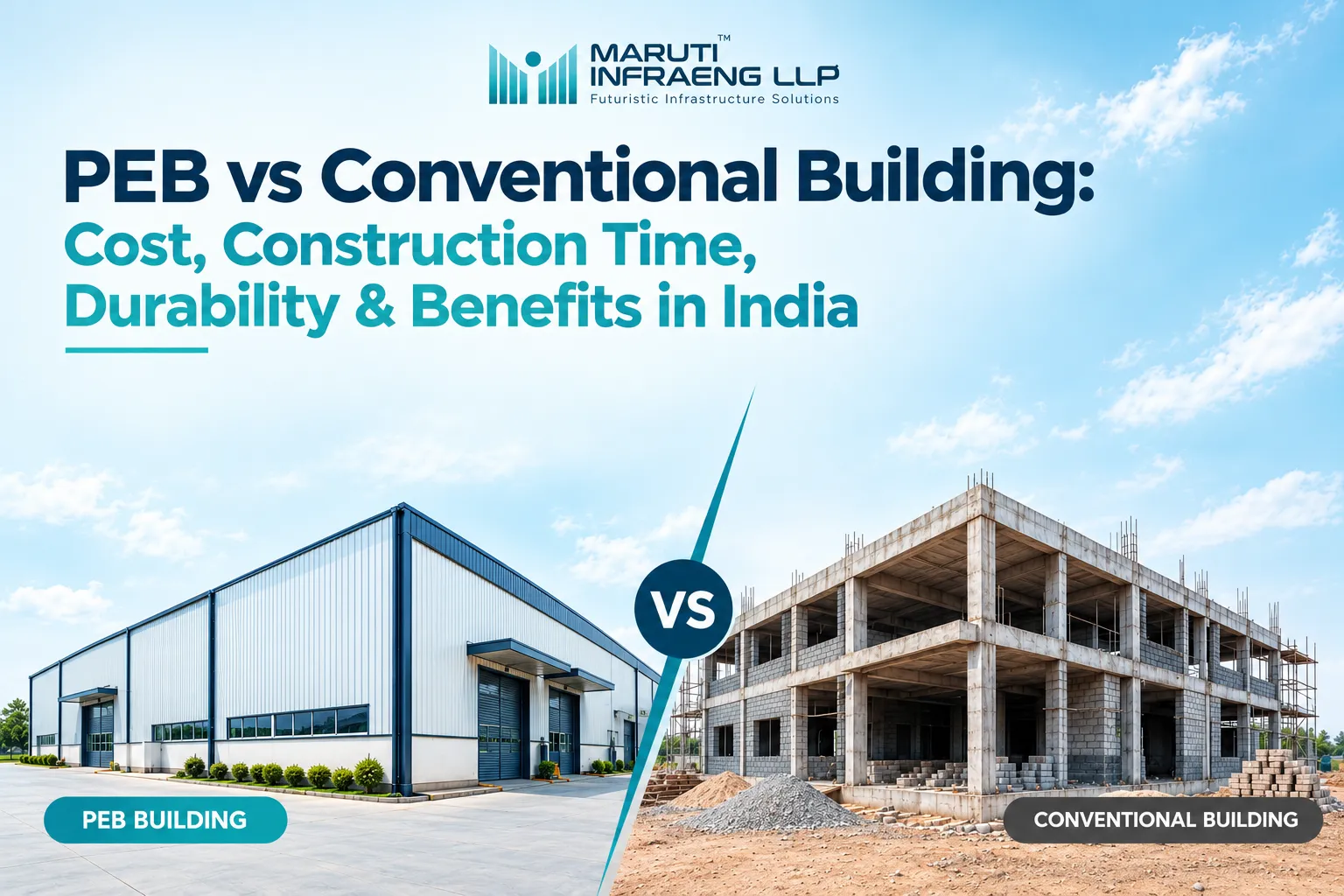
When planning a new industrial, commercial or large-scale
infrastructure project, the building structure is one of the decisions that can
influence everything from the initial budget to the project completion date.
For decades, conventional construction has been the familiar choice. But as
businesses look for faster execution, better material utilisation and greater
flexibility, Pre-Engineered Buildings (PEBs) have become an increasingly
practical option.
The real question, however, is not simply whether PEBs are better than conventional buildings. It is about understanding where each construction method works best and how factors such as cost, construction time, durability, design flexibility and long-term performance affect the overall value of a project.
Understanding
PEB and Conventional Construction
A Pre-Engineered Building is a structural system in which
major components are designed and engineered according to the specific
requirements of a project and manufactured in a controlled fabrication facility
before being transported to the site for assembly.
This approach brings design, detailing and fabrication
together as part of a coordinated process. Depending on the project, PEBs can
be used for warehouses, factories, workshops, logistics facilities, commercial
buildings, institutional structures and several other applications.
Conventional buildings, on the other hand, generally
involve more site-based construction. Structural elements may be fabricated or
assembled through traditional construction processes, with concrete, masonry
and structural steel used according to the building's design.
Both systems have their place. The difference lies largely
in how the building is designed, manufactured, transported and
assembled.
Why More
Businesses Are Exploring PEBs in India
For a business, construction is rarely just about putting
up four walls and a roof. Delays can affect production, storage, operations,
manpower and revenue. At the same time, structural decisions made during the
design stage can influence maintenance and future expansion.
This is where PEB construction presents an interesting
alternative.
“Time is money.” — Benjamin Franklin
While the quote is simple, its relevance to construction
remains strong. Every additional week spent waiting for a facility to become
operational can have a commercial impact.
A PEB system can bring greater coordination between
engineering and fabrication, allowing several activities to be planned before
materials reach the construction site. This can help reduce dependence on
extensive site-based fabrication and make project execution more streamlined.
For businesses working with defined timelines, that
difference can be particularly valuable.
PEB
Manufacturer in India: How Does Cost Compare?
Cost is often the first factor considered when comparing
PEBs with conventional buildings. However, comparing only the initial
structural cost does not provide the complete picture.
PEBs can offer cost advantages through optimised
structural design, controlled fabrication, reduced material wastage and faster
installation. Since components are engineered and fabricated according
to project requirements, the quantity and dimensions of materials can be
optimised rather than relying entirely on standard site-based construction
practices.
Conventional construction may involve greater dependence on
on-site activities, which can increase labour requirements and extend project
schedules depending on the complexity and location of the project.
The actual cost difference will vary based on factors such
as building size, location, design loads, span requirements, soil conditions,
architectural specifications, finishing, insulation, utilities and installation
requirements.
Therefore, a reliable PEB Manufacturer in India
should assess the complete project rather than quoting a structure based on a
simple per-square-foot comparison.
Key cost
considerations include:
·
Structural steel quantity and
grade
·
Foundation and civil work
requirements
·
Transportation and logistics
·
Erection and installation
·
Roofing and wall systems
·
Insulation requirements
·
Doors, windows and accessories
·
Fire and safety provisions
·
Future expansion requirements
·
Maintenance over the building's
operational life
The better comparison is therefore total project
value, rather than simply the lowest initial quotation.
Construction
Time: Where PEBs Can Make a Difference
Construction time is one of the strongest advantages
associated with PEB systems.
In a conventional project, structural work and other
construction activities can be heavily dependent on site progress. Weather,
labour availability, material handling and coordination between different teams
may influence the schedule.
With PEBs, structural components can be manufactured while
foundation and other site activities are progressing. Once the required
components reach the site, erection can proceed according to the engineered
installation plan.
This parallel approach can reduce the amount of time
required for structural assembly.
For an industrial or commercial business, faster completion
can mean earlier installation of machinery, earlier stocking of inventory and
earlier commencement of operations.
However, it is important to remember that PEB does
not mean instant construction. Foundation work, approvals,
transportation, utilities, flooring, internal systems and finishing still
influence the overall project timeline.
The advantage comes from better coordination and
prefabrication—not from eliminating construction activities altogether.
PEB
Manufacturer in India: Are PEBs Durable?
A common misconception is that faster construction means
compromising on durability. In reality, the performance of any steel building
depends heavily on engineering, material quality, fabrication accuracy,
protective systems and installation standards.
A properly designed and fabricated PEB can be engineered to
address the structural requirements of its intended application, including
relevant loads and environmental conditions.
For industrial and commercial buildings, durability also
depends on the protection provided to structural and external components.
Appropriate coatings, corrosion protection, roofing systems, drainage and
regular maintenance all contribute to long-term performance.
This is why selecting an experienced PEB
Manufacturer in India is important. The quality of the final building
is not determined by the concept of prefabrication alone. It depends on the
complete chain—from structural design and detailing to fabrication, logistics
and erection.
Design
Flexibility and Future Expansion
Another important consideration is how the building will be
used five or ten years from now.
Businesses change. Manufacturing capacity may increase,
storage requirements may grow, and new equipment may need to be accommodated. A
building designed only for today's requirements may eventually become
restrictive.
PEBs can offer considerable flexibility in terms of:
·
Large clear spans
·
Wide internal spaces
·
Customised building dimensions
·
Different roof configurations
·
Mezzanine requirements
·
Crane and equipment provisions
·
Future extensions
·
Integration of doors,
ventilation and other accessories
This makes PEB systems particularly relevant for
warehouses, manufacturing units, logistics centres and other facilities where
unobstructed internal space is important.
Conventional buildings can also be designed with
flexibility, but the process and cost of future modifications may differ
depending on the original structural system.
PEB vs
Conventional Building: A Practical Comparison
The right choice depends on the requirements of the
project, but the following comparison provides a useful starting point:
|
Factor |
PEB |
Conventional
Building |
|
Construction approach |
Components
engineered and fabricated before site erection |
Greater
reliance on site-based construction |
|
Construction speed |
Generally
faster structural erection |
Can
take longer depending on construction activities |
|
Material utilisation |
Engineered
for project-specific requirements |
Depends
on design and construction practices |
|
Site fabrication |
Comparatively
limited |
Often
higher |
|
Design flexibility |
Suitable
for wide spans and customised requirements |
Highly
flexible but may involve more site-based work |
|
Future expansion |
Can
be planned into the structural design |
Possible,
but may require more extensive modifications |
|
Quality control |
Fabrication
can be carried out in a controlled environment |
Quality
can depend significantly on site execution |
|
Best suited for |
Industrial,
warehouse, logistics and large-span applications |
Residential,
commercial and varied building applications |
This comparison should not be treated as a universal rule.
Every project needs to be evaluated according to its structural, architectural,
operational and budgetary requirements.
Choosing
the Right PEB Manufacturer in India
A building's performance depends not only on the structural
concept but also on the company responsible for bringing that concept to life.
For businesses considering PEB construction, it is worth
looking beyond the quotation and evaluating the manufacturer's engineering
capabilities, fabrication infrastructure, quality processes and installation
experience.
At Maruti InfraENG LLP, the focus is on
delivering next-generation steel infrastructure solutions covering
Pre-Engineered Buildings and structural steel.
The company brings together skilled engineering
professionals, modern software and advanced design and detailing practices to
develop steel structures for diverse requirements. Its capabilities extend from
designing and manufacturing to supplying and installing light, heavy and
complex steel structures.
Its structural steel division also handles detailing,
fabrication, supply and logistics, allowing different stages of the project to
be coordinated under one solution.
This integrated approach can be especially valuable for
projects where structural accuracy, execution planning and timely coordination
are critical.
PEBs Are
Not Just About Building Faster
The strongest case for PEB construction is not simply that
a building can be erected faster. The larger advantage lies in bringing engineering,
manufacturing and construction together as one coordinated process.
When the design is optimised, components are accurately
fabricated, logistics are planned and installation is properly executed,
businesses can gain a structure that meets their operational requirements while
making better use of time and resources.
At the same time, conventional construction remains an
appropriate choice for many projects, particularly where its construction
methods, architectural requirements or site conditions make it more suitable.
The decision should therefore begin with the project—not
with a construction trend.
PEB
Manufacturer in India: Making the Right Choice for Your Project
For businesses planning a factory, warehouse, industrial
facility or large-span structure, the question should not be “PEB or
conventional?” in isolation.
Instead, ask:
·
What is the required completion
timeline?
·
What type of internal space is
needed?
·
What are the structural and
environmental requirements?
·
Will the facility need future
expansion?
·
What is the complete project
budget?
·
How much site-based work can be
managed?
·
What engineering and
fabrication capabilities does the selected partner offer?
The answers will make it easier to determine which
structural approach makes sense.
Build
With the Right Structural Partner
Choosing a construction system is an important decision,
but choosing the right execution partner is equally significant.
With capabilities spanning Pre-Engineered
Buildings, structural steel, trusses, engineering, detailing, fabrication,
supply and installation, Maruti InfraENG LLP provides a complete steel
infrastructure solution for projects ranging from light structures to heavy and
complex applications.
If you are evaluating PEB construction for your next
industrial, commercial or infrastructure project, connect with Maruti
InfraENG LLP to discuss your structural requirements and explore a solution
designed around your project's needs.